
buying-guides
Golf course print styles explained: Contour, Mapping and Hole in one
What each family of Frame the Fairway print styles shows, how the Mapping and Contour twins differ, and how to choose one by room, occasion and course.
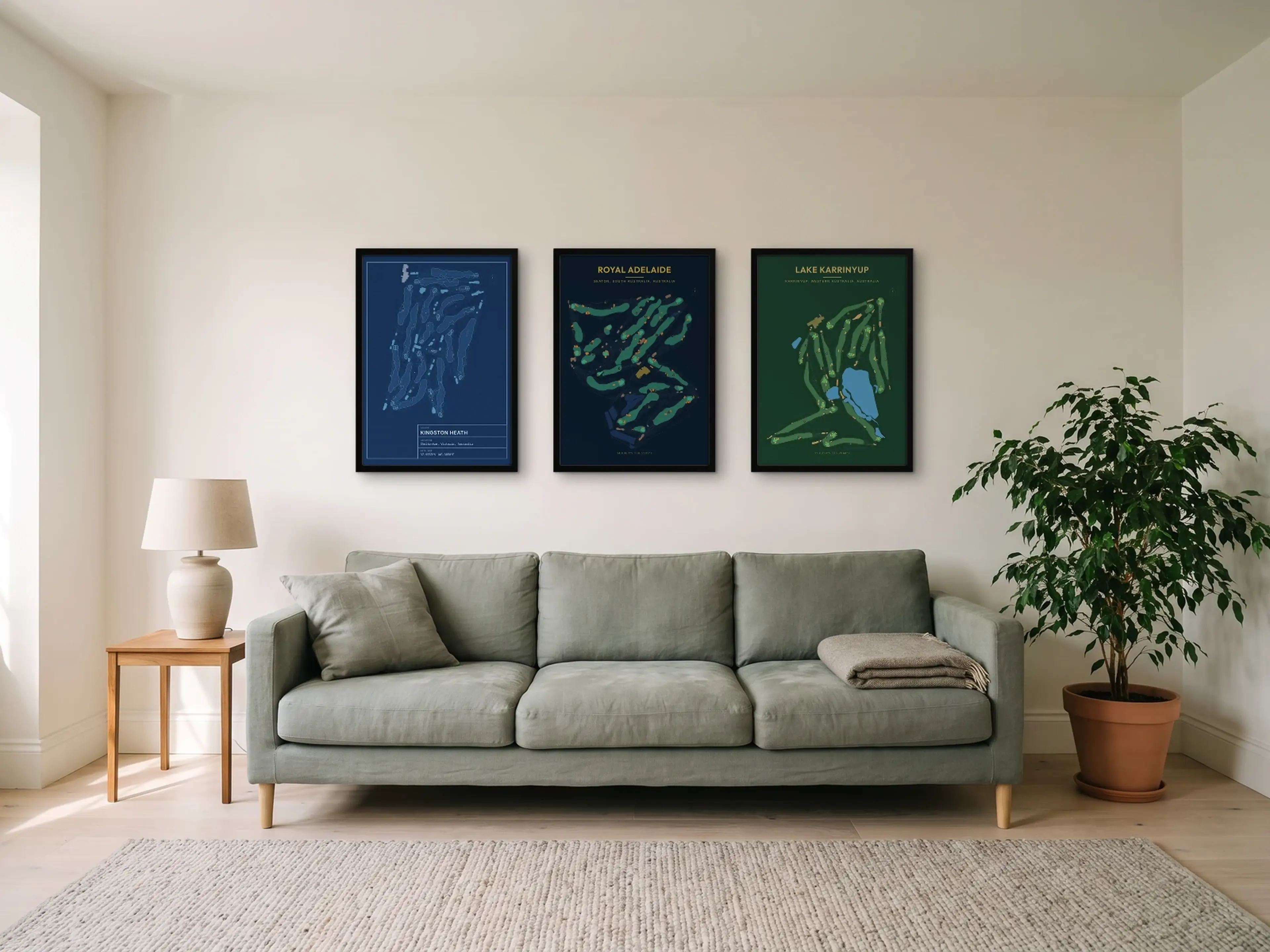
A Frame the Fairway golf course print comes in one of 19 styles, arranged in three families. Contour styles draw the course on its own: every hole, fairway, green, bunker and water hazard on a plain ground. Mapping styles draw the same course over its real surroundings, the streets, rivers and coastline around it, and Hole in one styles draw a single hole as a trophy, a club document or a graphic.
Every style is drawn from the same mapped course data, so the routing is identical whichever you pick. The style decides the colours, the type and how much of the world around the course appears. This guide explains what each family shows, how to tell the Mapping and Contour twins apart, and how to choose one for a room, an occasion or a particular course. You can see every style on any course in the editor, and the styles page shows them side by side.
What are the three families of golf course print styles?
The style picker in the editor has three tabs, and each tab is a family. The families differ in what they draw, not just in colour.
| Family | What it shows | Best for |
|---|---|---|
| Contour | The whole course on a plain ground: every hole, fairway, green, bunker and water hazard, with the course name and location | Their home course, a course they have played for years, a clean print for a study or office |
| Mapping | The whole course plus its real surroundings: streets, rivers, lakes and coastline, drawn from OpenStreetMap | Coastal and links courses, city courses, a course tied to a town or a trip |
| Hole in one | A single chosen hole, set out as a trophy, a club document or a graphic, with the date and the player | A hole-in-one, a favourite hole, a club honour |
Contour: the course on its own
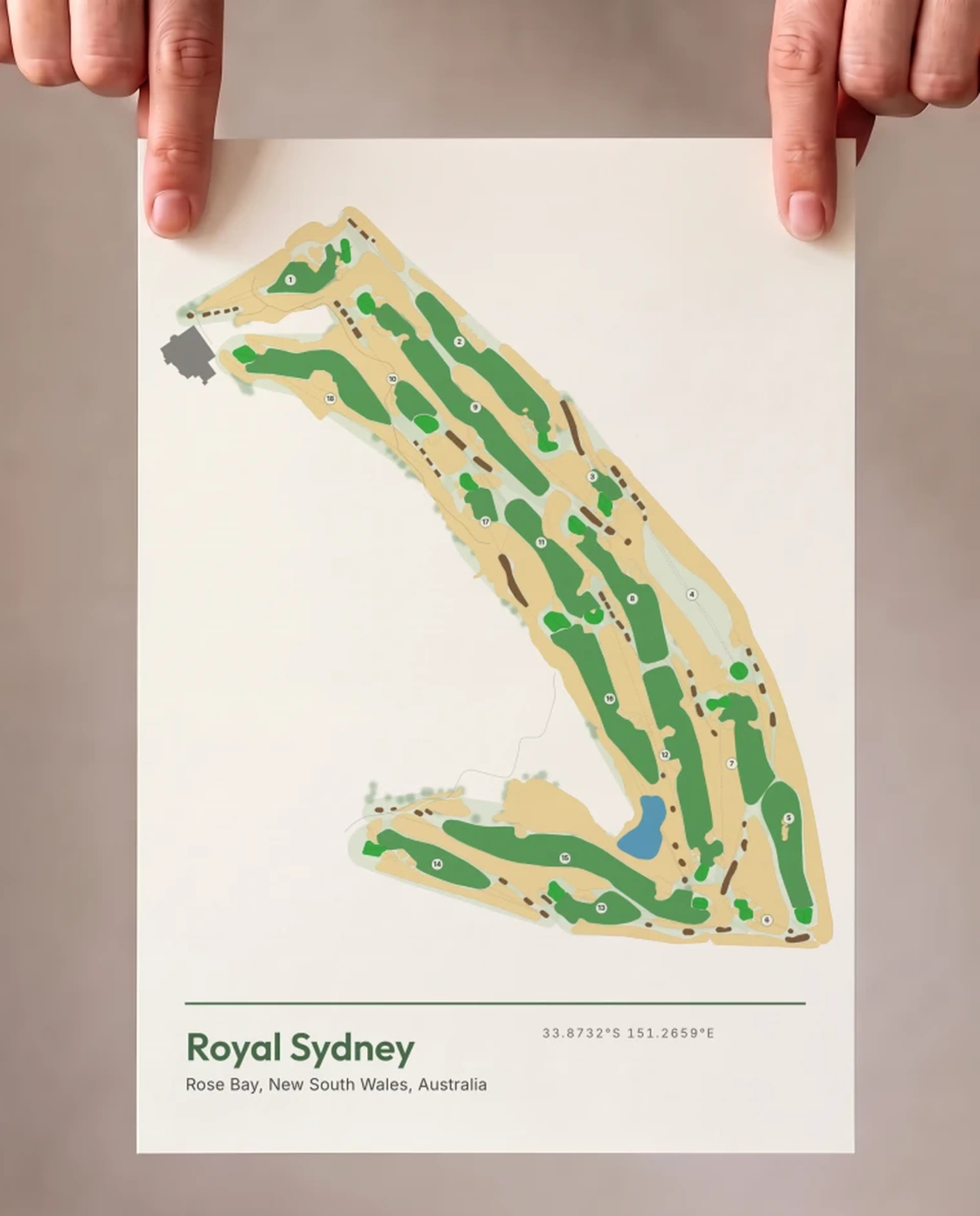
Contour is the largest family and the one most people start with. It draws the routing of every hole on the course on a plain sheet, with nothing around it. The shape of the course becomes the picture: the way Kingston Heath packs its holes into a tight rectangle, or the way Royal Sydney bends along its boundary.
Light grounds:
Classic Light: natural course colours on a light ground.
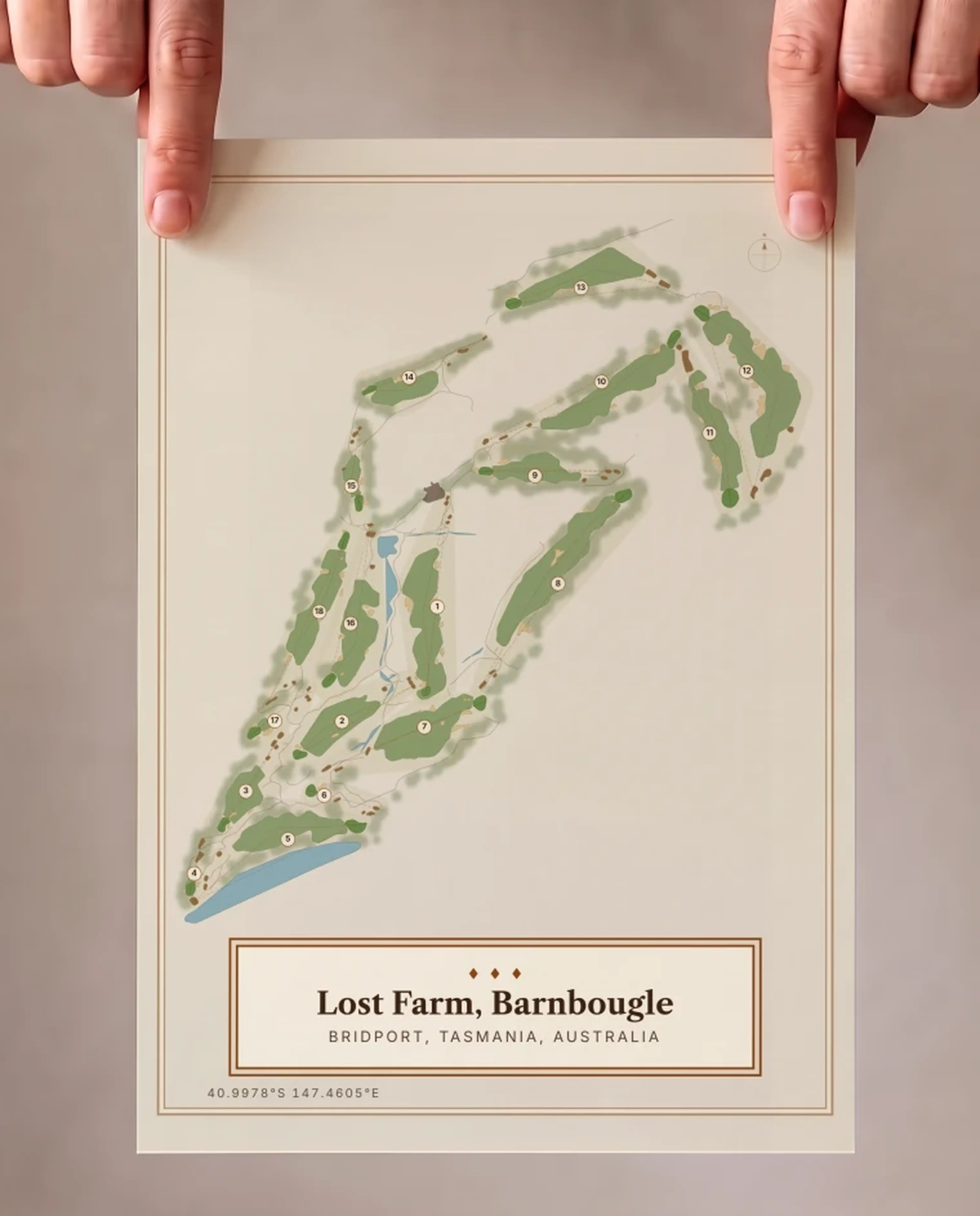
Natural: realistic greens on warm cream, with a gallery-style caption.
Broadsheet: high-contrast black linework on white.
Press: flat spot colours, pulled slightly out of register, like an old two-colour print.
Vintage: an aged map on parchment, titled in a framed cartouche.
Sandstone: warm cream with terracotta and teal.
Mist: pale blue-grey, with features picked out in white.
Dark grounds:
Classic Dark: dark green with gold accents.
Emerald: deep emerald with mint highlights.
Midnight: deep blue with gold routing.
Blueprint: an architectural drawing on navy, with a title block in the corner.
Slate: dark slate-blue with white linework.
Gilt: gold on black, in the manner of a foil print.
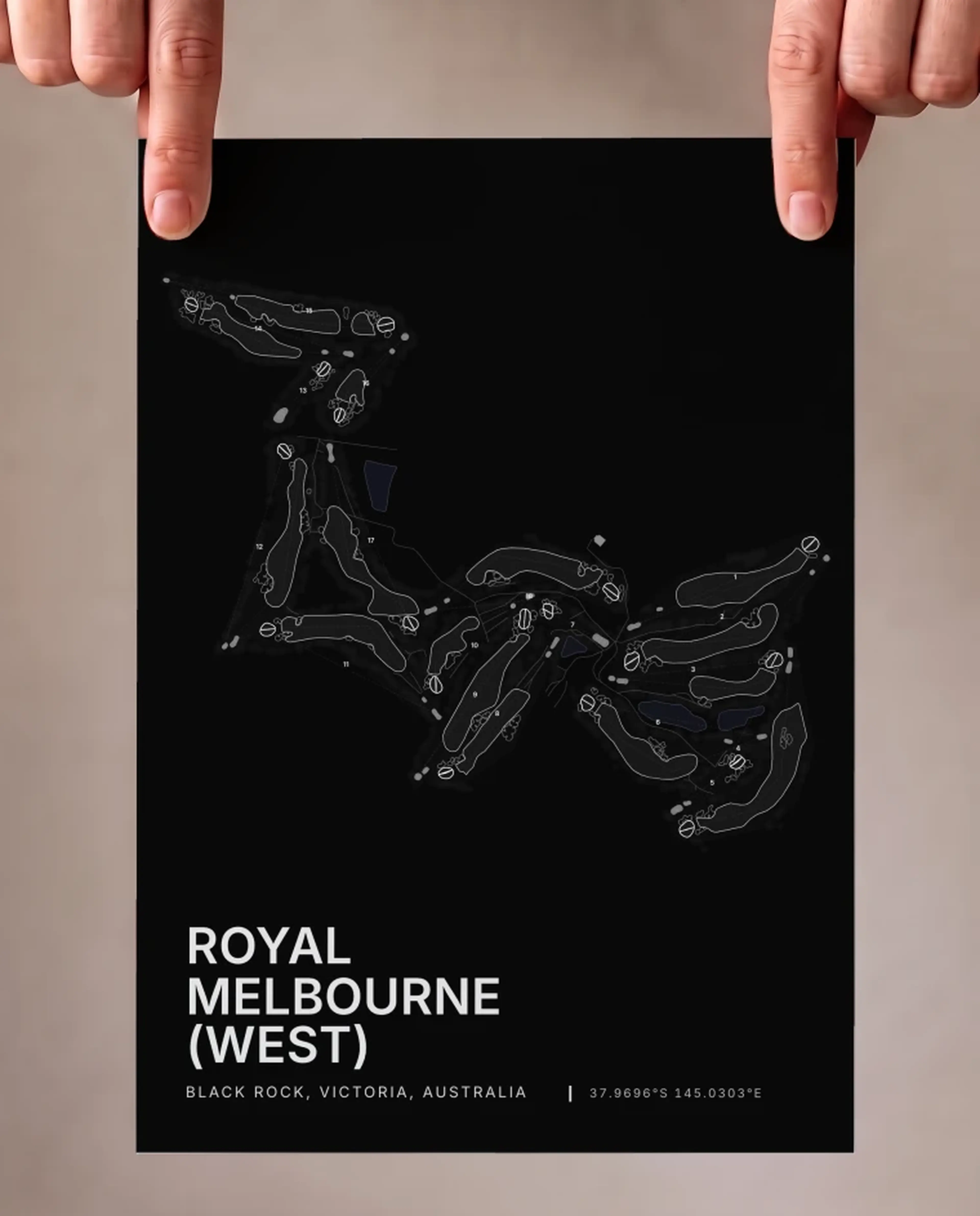
Noir: white outlines on black, nothing else.
Mapping: the course and the ground around it
Mapping styles draw the same course, then add what surrounds it: the street grid, the rivers and lakes, the coastline, the town the course sits in. The surroundings come from OpenStreetMap, the open map built by volunteers, and each Mapping print carries a small OpenStreetMap credit. The course itself is still drawn from mapped course data, so the holes are as precise as in a Contour print.
The point of Mapping is context. A Contour print of a links course shows the holes; a Mapping print shows the holes running along the sea. A city course stops being an island of green and becomes a shape inside the suburb it belongs to.
There are five Mapping styles:
Plan: the whole map as a clean black-and-white plan.
Haze: pale blue-grey, with roads and water picked out in white.
Terracotta: a warm cream ground with rust roads and teal water.
Graphite: dark slate-blue, with the road network in white.
Gold Leaf: a gold road network on black, in the manner of a foil print.
Which Mapping and Contour styles are twins?
Each Mapping style has a Contour twin with the same palette and no surroundings. If you like the colours of one but want more, or less, of the world around the course, switch to its twin:
Plan and Broadsheet: black and white.
Haze and Mist: pale blue-grey and white.
Terracotta and Sandstone: warm cream, rust and teal.
Graphite and Slate: dark slate-blue and white.
Gold Leaf and Gilt: gold on black.
The twins make a good pair on one wall. Hang the Mapping version of their home course beside the Contour version of a course they travelled to, and the two read as a set.
Hole in one: a single hole
Hole in one styles draw one hole rather than the whole course. The tab appears in the style picker once a hole is chosen in the editor. The three styles differ in kind, not just in colour:
Ace: dark and gilded, the trophy on the wall.
Scorecard: cream stock and ink, the way the club records it.
Signature: monochrome, with the green picked out in colour.
Add the hole number, the date, the player's name and a short message, and the print records the shot the way an honours board would. It is not limited to aces: a signature hole, the hole they eagled, or the 18th where they won the club championship all work. Our guide to hole-in-one gifts covers the rest of the occasion.
See their course in every style before you choose
Open the editorHow do I choose a style for the room?
Start with the wall. A dark style (Classic Dark, Emerald, Midnight, Blueprint, Slate, Gilt, Noir, Graphite or Gold Leaf) sits well on a white or pale wall, where it reads as a strong block. A light style (Classic Light, Natural, Broadsheet, Press, Vintage, Sandstone, Mist, Plan, Haze or Terracotta) suits a darker or painted wall, where it lifts the colour rather than disappearing into it.
Then match the room's materials. Vintage, Sandstone and Terracotta sit naturally with timber furniture, leather and warm colours. Broadsheet, Plan and Noir suit a modern room with black and white in it. Blueprint and Midnight work in a study or office with navy or grey. For frame colours and hanging, see how to style golf course art, and for a whole study or games room, golf wall art for the home office.
If the print is a gift and you do not know the room, a light Contour style such as Classic Light or Natural in a Black or Natural frame is the safest choice. It suits most walls and puts the course first.
How do I choose a style for the occasion?
A hole-in-one: a Hole in one style, with the date and the hole. Ace if it will hang with trophies, Scorecard if it will hang in the clubhouse or beside the real card.
Their home course: Contour, because the shape of the course they play every week is the subject.
A golf trip or a bucket-list round: Mapping, because it puts the course in the town or the coastline they travelled to. See our bucket-list courses for ideas.
A retirement or a club milestone: a dark Contour style with the dates and a message. Our retirement gift guide has more.
A club or company order: a consistent style across every print, often Classic Dark or Classic Light, so a row of courses reads as one set. See /corporate for club and company orders.
How do I choose a style for the course?
Some courses suit one family better than another:
Coastal and links courses read well in Mapping, because it draws the coastline. On a course that runs along the sea, the shoreline is half the picture. Our lists of the best links courses in the UK and Ireland and Australia's most scenic courses have plenty of candidates.
Heathland and parkland courses with a compact routing read well in Contour, where the holes fill the sheet.
City courses gain from Mapping, which shows the streets that box the course in.
Courses with one famous hole, a short par 3 over water for example, suit Hole in one. Our piece on iconic golf holes has a few.
The quickest test is to open the course in the editor and switch between a Contour style and its Mapping twin. If the surroundings add something, keep Mapping; if they crowd the course, go back to Contour.
Not sure which course they play?
The style is the easy part. If the print is a gift, you need the course first, and there is no voucher option. Our guide to finding out which golf course someone plays covers the quiet ways to ask. With a deadline in mind, check Christmas golf gift delivery dates.
Does the style change the price or the size?
No. Every style prints at every size from A4 to A0 (The Gallery stops at A2) and on every tier, and the style does not change the price. Prints start from $99 unframed, from $149 framed in The Classic, and a digital Instant download is $49. Because every size shares the same proportions, the artwork is identical at A4 and A0; only the scale changes. Our golf print size guide helps with the size.
Golf course print styles: common questions
How many golf course print styles are there?
Frame the Fairway offers 19 styles in three families: Contour, which draws the course on its own; Mapping, which draws it over its surrounding streets and coastline; and Hole in one, which draws a single hole. You can preview any course in every style in the editor before ordering.
What is the difference between Contour and Mapping styles?
Contour styles draw only the course, on a plain ground. Mapping styles draw the same course over its real surroundings, the streets, rivers and coastline, taken from OpenStreetMap. Each Mapping style has a Contour twin in the same colours, so you can compare the two directly.
Can I get a print of a single golf hole?
Yes. Choose a hole in the editor and the Hole in one tab appears, with three styles: Ace, Scorecard and Signature. You can add the date, the player's name and a message, which makes it a common choice for a hole-in-one or a favourite hole.
Which golf course print style is best for a gift?
If you do not know the room, a light Contour style such as Classic Light or Natural is the safest choice, because it suits most walls. For a hole-in-one, use a Hole in one style. For a trip or a coastal course, a Mapping style shows where the course sits.
Can I see the style on their course before I order?
Yes. Open the course in the editor and switch between styles; the preview redraws their course in each one, with your text. Your layout, text and details print exactly as shown, so check names and dates on the preview before you order.
Pick the course, then try every style
Search 40,000 courses, switch between Contour, Mapping and Hole in one, and add the names and dates before you order.
Design their print