
courses-travel
Kingston Heath, hole by hole: par, stroke index and distances
All 18 holes of Kingston Heath with par, stroke index, straight-line distance and green depth from our mapped course data, plus Soutar’s routing, MacKenzie’s bunkering and the par-3 15th.
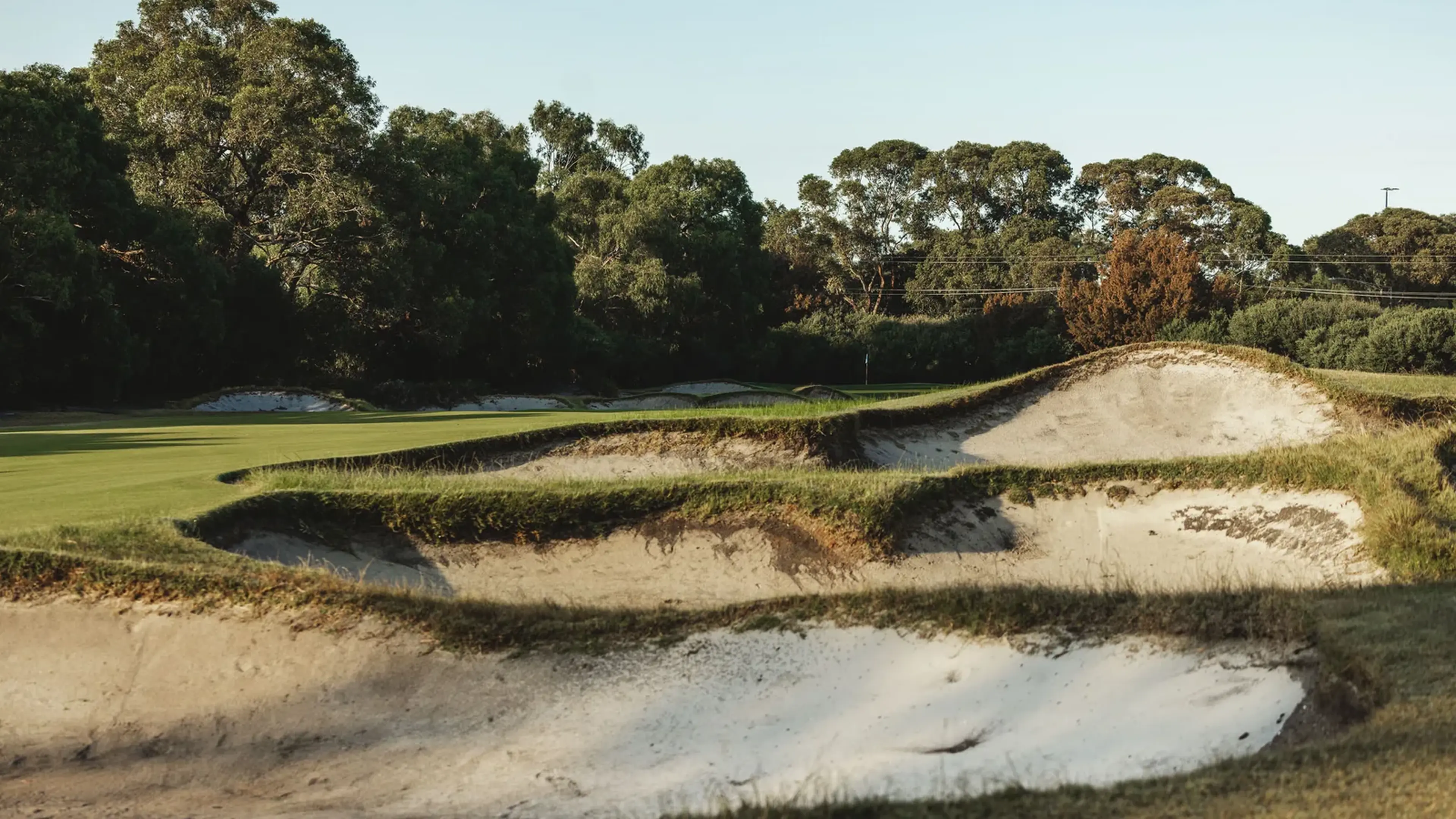
Kingston Heath is a par 72, 36 out and 36 in, with three par 3s (the 5th, 10th and 15th), three par 5s (the 7th, 12th and 14th) and twelve par 4s. On our mapped course data the longest hole is the 12th, at 523 metres in a straight line from the back tee to the centre of the green, and the shortest is the 10th at 122 metres. The 16th is stroke index 1.
Every distance in this guide is a straight-line distance, back tee to centre of green, measured on our mapped course data. It is the distance as the crow flies. On a hole that bends, the distance you play is longer, so these numbers will not match the scorecard, and the card changes with the tee you play from. Added together, the 18 straight-line distances come to 6,259 metres from the back tees and 5,460 metres from the forward tees.
The course is in Cheltenham, in Melbourne’s south-east, on the Sandbelt. The club says it sits on about 50 hectares of relatively flat ground, which is small for a championship course, and it will host the Presidents Cup in 2028.
Who designed Kingston Heath?
Dan Soutar, a professional originally from Carnoustie, designed the routing. The club began as the Elsternwick Golf Club in 1909, bought its present site in Cheltenham in 1923, and opened the new course on 4 April 1925. Royal Melbourne lent its head greenkeeper, Mick Morcom, to build it, helped by his son Vernon. Soutar’s design measured 6,812 yards, which made it the longest course in the country at the time.
According to the club, Soutar walked the property several times and then stopped at a clearing among gum trees near its centre: “Here is where we start, an ideal ready-made short hole for the 10th.” He planned the rest of the course around that green.
The course opened without bunkers. Money was tight, and the committee wanted the course to settle in, and it knew Dr Alister MacKenzie was due in Melbourne in 1926 to design Royal Melbourne’s West Course. MacKenzie inspected Kingston Heath on 29 October 1926 and sent a bunkering scheme three weeks later, with a fee of £250. He also suggested shortening several holes; the committee said no to all of them except one, the 15th. That is why the club credits the course to Soutar’s design and MacKenzie’s bunkering.
Kingston Heath scorecard from our mapped data
The table lists all 18 holes. Green depth is the length of the putting surface front to back, also from our mapped data; it runs from 25 metres on the 3rd and 5th to 37 metres on the 10th. Stroke indexes are set by the club and can be revised, so check the current card before a competition round.
| Hole | Par | Stroke index | Straight-line, back tee (m) | Green depth (m) |
|---|---|---|---|---|
| 1 | 4 | 4 | 410 | 28 |
| 2 | 4 | 8 | 319 | 34 |
| 3 | 4 | 16 | 274 | 25 |
| 4 | 4 | 10 | 348 | 33 |
| 5 | 3 | 12 | 166 | 25 |
| 6 | 4 | 2 | 390 | 36 |
| 7 | 5 | 18 | 454 | 30 |
| 8 | 4 | 6 | 379 | 28 |
| 9 | 4 | 14 | 299 | 32 |
| 10 | 3 | 17 | 122 | 37 |
| 11 | 4 | 3 | 371 | 27 |
| 12 | 5 | 9 | 523 | 26 |
| 13 | 4 | 13 | 333 | 34 |
| 14 | 5 | 15 | 514 | 26 |
| 15 | 3 | 11 | 138 | 35 |
| 16 | 4 | 1 | 399 | 29 |
| 17 | 4 | 5 | 407 | 30 |
| 18 | 4 | 7 | 413 | 36 |
Out, the straight-line distances add up to 3,039 metres; in, 3,220 metres. Both of the long par 5s are on the back nine, and the last three holes are all par 4s of around 400 metres in a straight line.
The 15th: MacKenzie’s one change
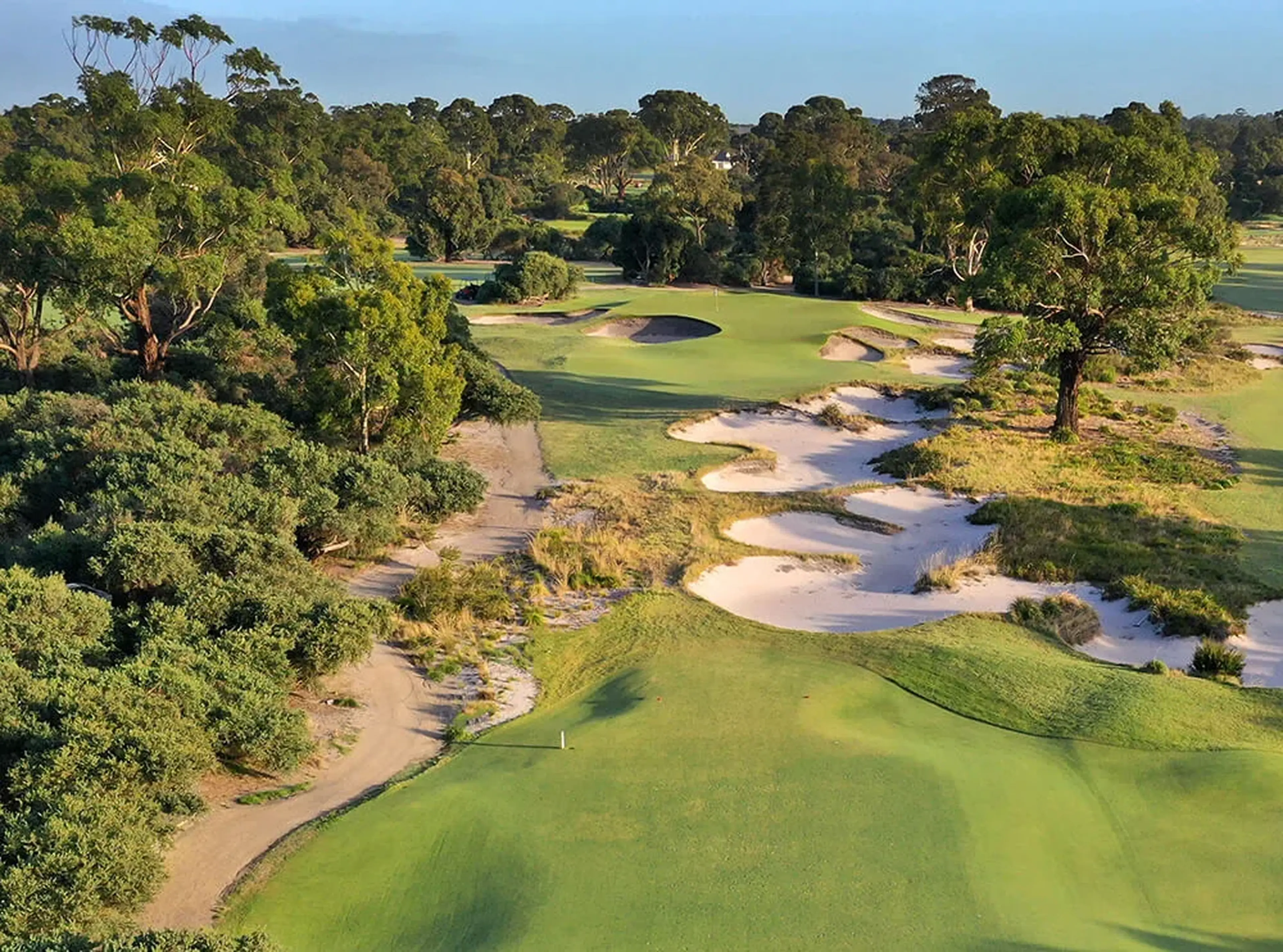
The 15th is the hole Kingston Heath is known for. In Soutar’s layout it was a blind par 4 of 222 yards, played over a ridge that crossed the fairway. MacKenzie moved the green to the top of that ridge, the highest point on the course, and turned it into an uphill par 3. It was the only change of his that the club adopted.
On our data the 15th is 138 metres in a straight line from the back tee to the centre of the green, and the green is 35 metres deep, one of the deepest on the course. Between tee and green is a field of bunkers and sandy scrub; the putting surface sits above them, so a tee shot that comes up short finishes in sand or scrub. It is stroke index 11.
The 3rd: the short par 4
The club gives the 3rd as 271 metres; our straight-line figure is 274 metres. It looks drivable from the tee, and it is stroke index 16, but the green is shallow: 25 metres front to back on our data, the joint shallowest on the course. The club describes the strategy as thinking backwards from the flag: the pin position decides which side of the fairway you want, and the tee shot follows from that.
The 10th: where the routing started
The 10th is the shortest hole on the course, 122 metres in a straight line, and it has the deepest green in our data at 37 metres. It is also where Soutar began. The clearing he chose in 1925 is still the green, with bunkers in front and on both sides.
The 16th and the finish
The 16th is stroke index 1, a par 4 of 399 metres in a straight line, with bunkers on the right of the fairway and the right of the green. The 17th (407 metres, stroke index 5) and the 18th (413 metres, stroke index 7) follow, so three of the seven hardest holes on the card come in a row at the end.
Visiting
Kingston Heath is a private club. Its website says it welcomes interstate and international visitors at set times, subject to availability, on Mondays, Tuesdays, Thursday afternoons during daylight saving and Fridays, and not at weekends. Visitors must belong to a recognised golf club and bring current membership identification or a letter of introduction from their home club. Check with the club before you plan around it.
How do I turn Kingston Heath into a print?
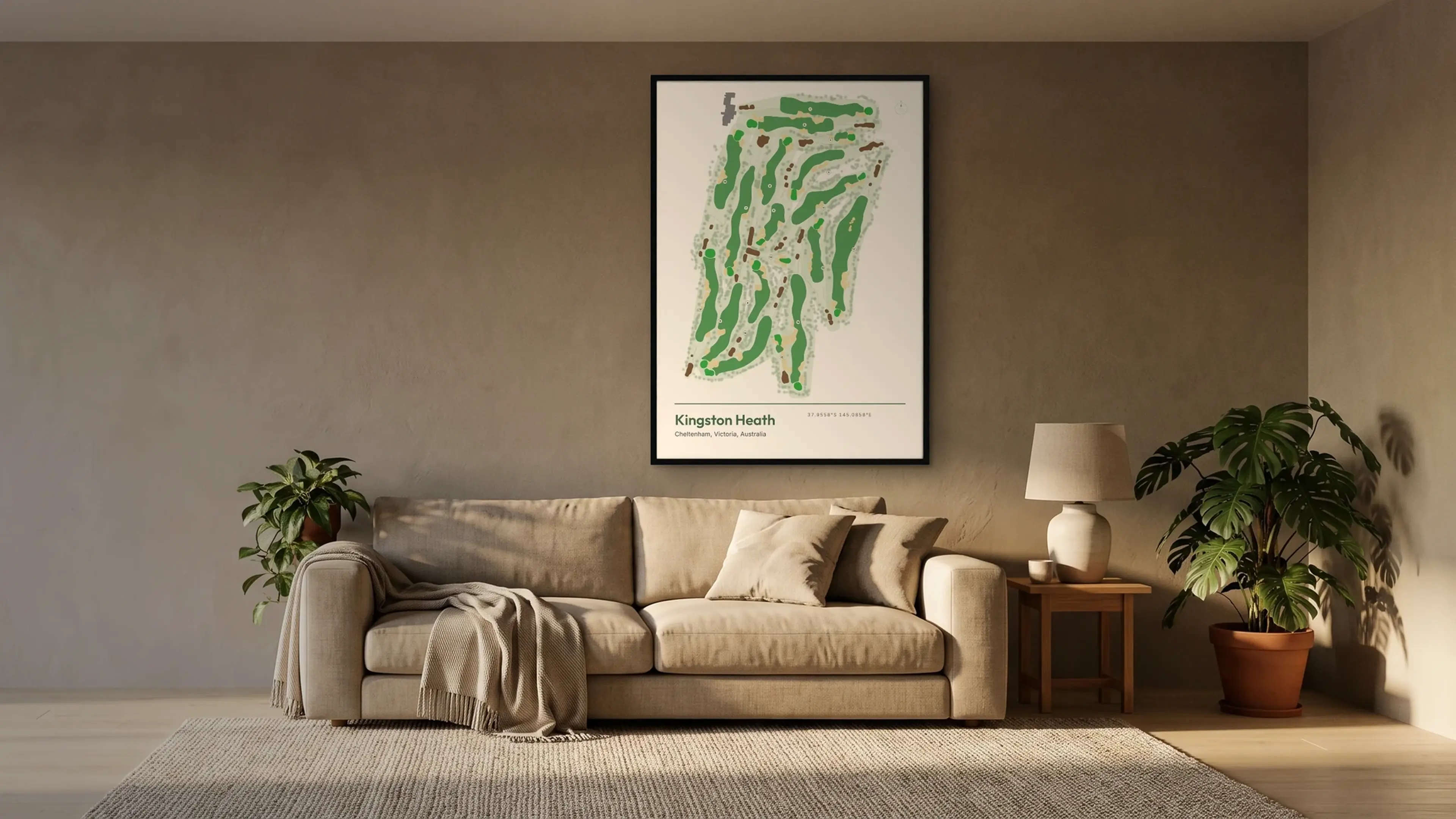
Every hole at Kingston Heath is already drawn from the same mapped course data used for this guide.
Hole in one. One hole as the subject, with a name and a date. The 15th is the obvious choice for an ace; the 5th and 10th are the others.
Contour. The whole course drawn on its own, with the tight routing and every bunker in place.
Mapping. The course drawn over the streets of Cheltenham around it.
Sizes run from A4 to A0. The Classic starts from $149, The Studio from $179, and Print only from $99. Instant, a 300 dpi PNG emailed within minutes of payment, is $49. Standard delivery within Australia takes 4–9 business days, and it is included on The Classic and The Studio from A4 to A2 and on every Print. Every print is made to order, so we can't accept returns or exchanges for change of mind. But if your order arrives damaged, or with a fault on our end, tell us within 14 days of receiving your print and we'll reprint it at no extra cost, or refund you in full.
For order-by dates and more ideas, see Christmas golf gifts in Australia.
Kingston Heath, every hole drawn
Open Kingston Heath in the editor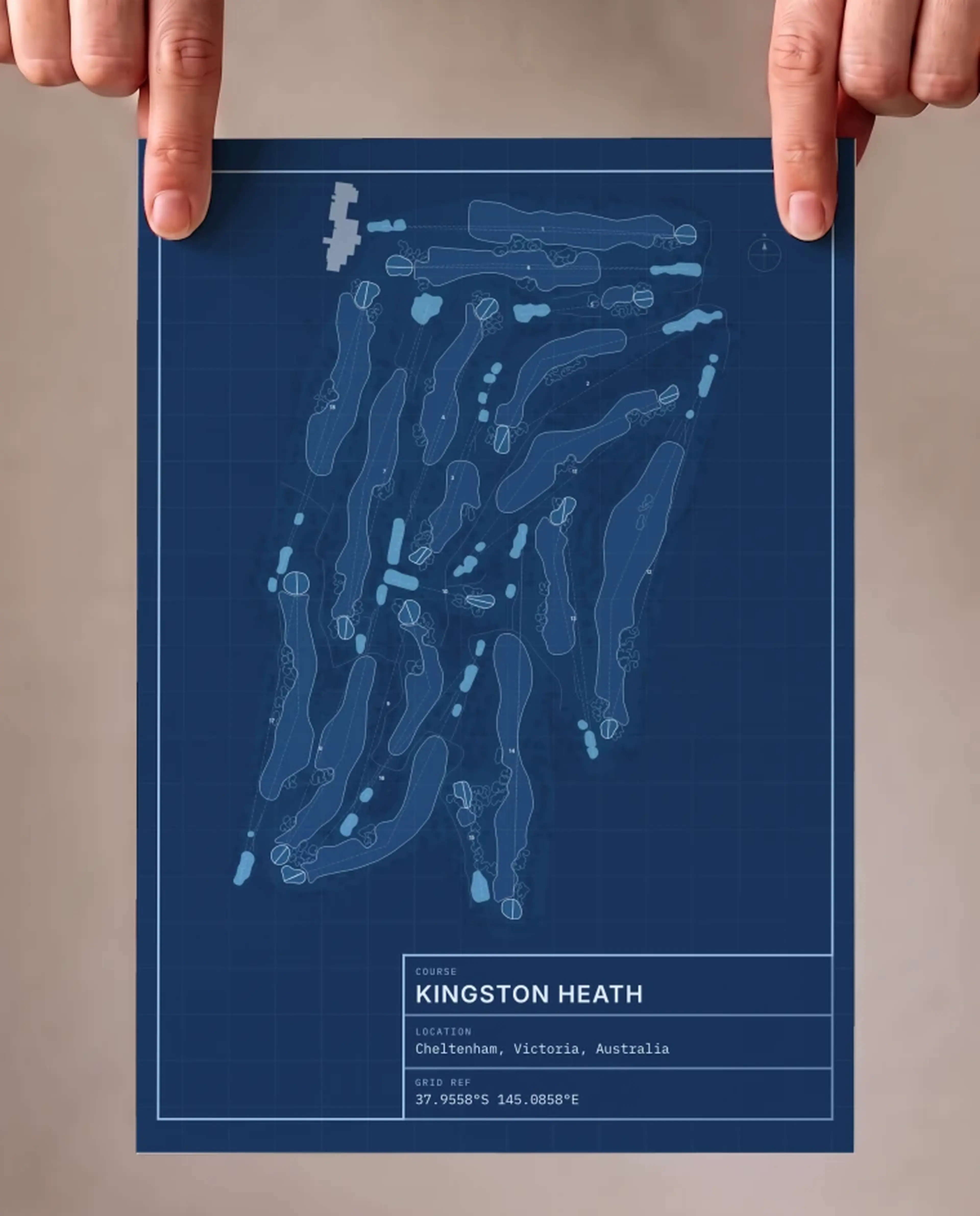
More hole-by-hole guides
MacKenzie designed the course he came to Melbourne for: see Royal Melbourne West, hole by hole. For the links that shaped his thinking, see the Old Course at St Andrews, hole by hole and our guide to the best links courses in the UK and Ireland. Closer to home, Australia’s most scenic golf courses covers the rest of the country, and iconic golf holes and their stories the famous holes elsewhere.
Kingston Heath: common questions
How long is Kingston Heath?
On our mapped course data, the straight-line distances from the back tees to the centre of each green add up to 6,259 metres, and 5,460 metres from the forward tees. The playing length on the card is longer on holes that bend, and it changes with the tee you play from, so check the club’s card for the current figures.
Who designed Kingston Heath?
Dan Soutar designed the routing, and Mick Morcom built the course, which opened in April 1925. Dr Alister MacKenzie drew up the bunkering in 1926 and turned the 15th from a blind par 4 into an uphill par 3.
Can the public play Kingston Heath?
Kingston Heath is a private members’ club, but it takes interstate and international visitors on set weekdays, subject to availability. Visitors must belong to a recognised golf club and show membership identification or a letter of introduction. Contact the club for current times and fees.
What is the signature hole at Kingston Heath?
The par-3 15th. MacKenzie placed its green on top of the ridge at the highest point of the course, behind a field of bunkers. On our data it is 138 metres in a straight line from the back tee to the centre of the green.
Is Frame the Fairway connected to Kingston Heath Golf Club?
No. We are not affiliated with or endorsed by Kingston Heath Golf Club. Our prints are drawn from mapped course data of the course as it lies on the ground.
The 15th, or all eighteen
Pick a hole and a date, or print the full course in Contour or Mapping.
Start with Kingston Heath