
courses-travel
The Old Course at St Andrews, hole by hole: par, stroke index and distances
All 18 holes of the Old Course at St Andrews with par, stroke index, straight-line distance and green depth from our mapped course data, plus the stories of the Road Hole, Hell Bunker and the Swilcan Bridge.
The Old Course at St Andrews is a par 72, 36 out and 36 in, with two par 3s (the 8th and 11th), two par 5s (the 5th and 14th) and fourteen par 4s. On our mapped course data the longest hole is the 5th, at 517 metres in a straight line from the back tee to the centre of the green, and the shortest is the 11th at 160 metres. The 14th, the hole with Hell Bunker, is stroke index 1.
Every distance in this guide is a straight-line distance, back tee to centre of green, measured on our mapped course data. It is the distance as the crow flies. On a hole that bends, the distance you actually play is longer, so these numbers will not match the scorecard, and the card itself changes with the tee you play from. Treat them as a measure of where things sit on the ground, not as the card length. Added together, the 18 straight-line distances come to 6,376 metres from the back tees and 5,573 metres from the forward tees.
The Old Course is a public course on common land, run by St Andrews Links Trust, and it has hosted The Open 30 times, most recently in 2022. If you are reading this because someone you know has played it, or is about to, the last section covers how any hole on it becomes a print. If you want the wider picture first, our guide to the best links courses in the UK and Ireland puts it alongside its neighbours.
The Old Course scorecard from our mapped data
The table lists all 18 holes. Green depth is the length of the putting surface front to back, also from our mapped data. The Old Course has seven double greens shared by two holes, and the 5th and 13th share the largest: it measures 90 metres front to back. Stroke indexes are set by the club and can be revised, so check the current card before a competition round.
| Hole | Par | Stroke index | Straight-line, back tee (m) | Green depth (m) |
|---|---|---|---|---|
| 1, Burn | 4 | 10 | 334 | 38 |
| 2, Dyke | 4 | 6 | 359 | 22 |
| 3, Cartgate (Out) | 4 | 16 | 312 | 47 |
| 4, Ginger Beer | 4 | 8 | 381 | 42 |
| 5, Hole O'Cross (Out) | 5 | 2 | 517 | 90 |
| 6, Heathery (Out) | 4 | 12 | 371 | 40 |
| 7, High (Out) | 4 | 4 | 334 | 23 |
| 8, Short | 3 | 14 | 174 | 45 |
| 9, End | 4 | 18 | 316 | 38 |
| 10, Bobby Jones | 4 | 15 | 348 | 46 |
| 11, High (In) | 3 | 7 | 160 | 41 |
| 12, Heathery (In) | 4 | 3 | 325 | 36 |
| 13, Hole O'Cross (In) | 4 | 11 | 402 | 90 |
| 14, Long | 5 | 1 | 474 | 36 |
| 15, Cartgate (In) | 4 | 9 | 404 | 45 |
| 16, Corner of the Dyke | 4 | 13 | 377 | 35 |
| 17, Road | 4 | 5 | 447 | 49 |
| 18, Tom Morris | 4 | 17 | 341 | 41 |
Out, the straight-line distances add up to 3,098 metres; in, 3,278 metres. The back nine is the longer half on the ground, and it holds three of the four longest holes: the 14th, the 17th and the 15th.
Why does the Old Course have double greens?
The course goes out and comes back along the same narrow strip of linksland, so holes going opposite ways share fairways and, on seven occasions, a green. The current layout has seven double greens and four single greens; the single greens serve the 1st, 9th, 17th and 18th. On every shared green the two hole numbers add up to 18: the 2nd and 16th, 3rd and 15th, 4th and 14th, 5th and 13th, 6th and 12th, 7th and 11th, and 8th and 10th. The outward holes fly white flags and the inward holes red ones, so you can tell which flag is yours.
The course reached 18 holes in 1764. Until then it had 22, and the golfers of St Andrews combined the first four and last four holes into four, which is how a round there became 18 holes.
The 1st and 18th: the Swilcan Burn and the bridge
The 1st, called Burn, and the 18th, called Tom Morris, share one very wide fairway, with the Swilcan Burn crossing in front of the 1st green. Our data marks the water as a carry in front of the 1st green and across the middle of the 18th fairway. In a straight line the 1st is 334 metres and the 18th 341 metres.
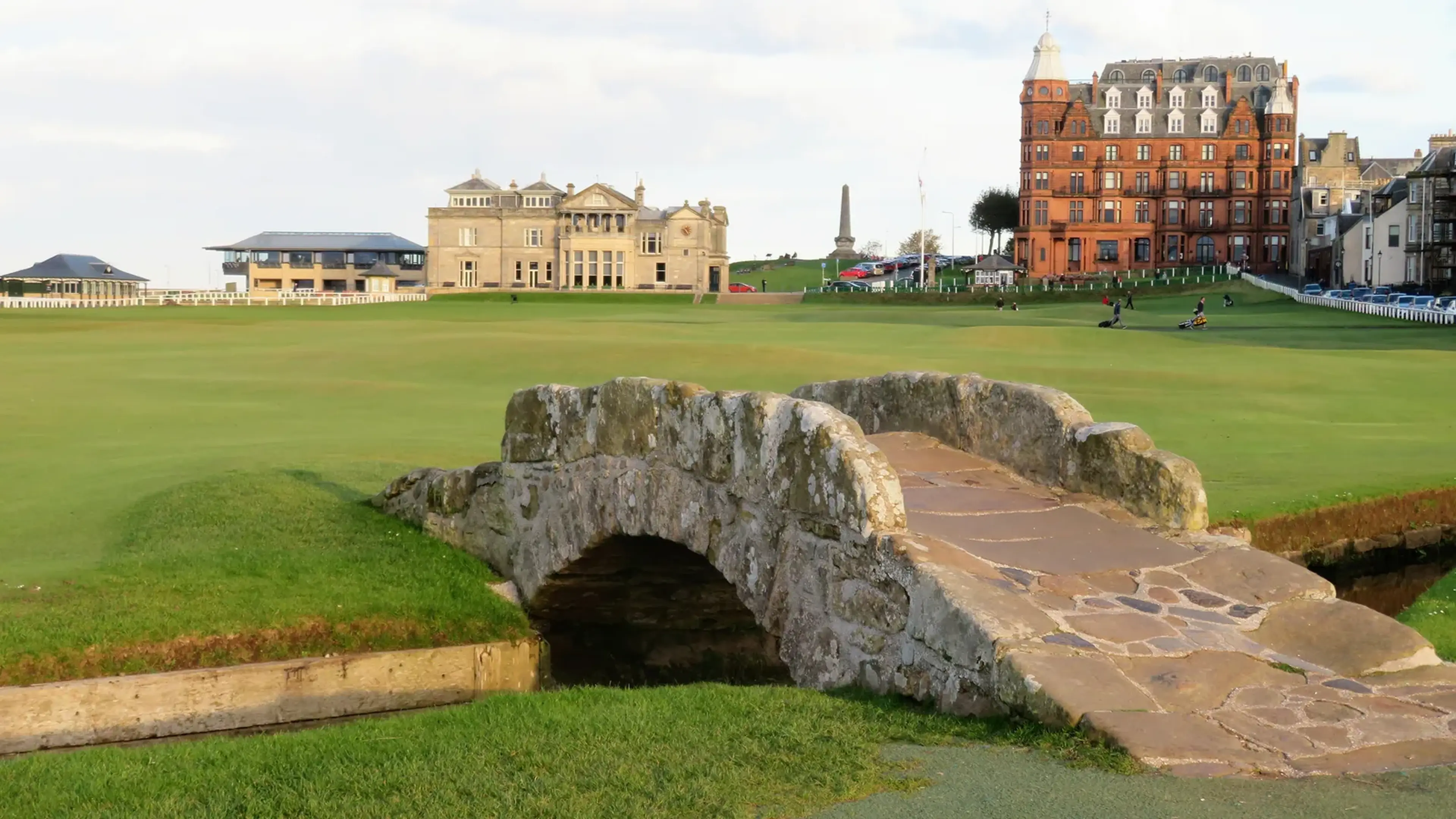
The Swilcan Bridge carries golfers over the burn on the walk up the 18th. It is a small stone footbridge, about 9 metres long and 2.4 metres wide, and the place where golfers stop for a photo. The 18th green sits in front of the R&A clubhouse, and in front of the green is the Valley of Sin, a hollow about 2.4 metres deep that sends short approaches back down the slope. Old Tom Morris, after whom the hole is named, designed both the 1st and the 18th.
The 5th and 13th: Hole O’Cross and the biggest green
The 5th is the longest hole on our data at 517 metres in a straight line, and stroke index 2. Its green is shared with the 13th, and at 90 metres front to back it is the deepest green on the course. A long approach that finds the wrong side of it can leave a putt longer than many par 3s.
The 14th: Long, and Hell Bunker
The 14th is stroke index 1 and a par 5 of 474 metres in a straight line. Its name is simply Long. The hazard everyone knows on it is Hell Bunker, which covers about 250 square metres and is between 2.1 and 3.0 metres deep. It sits in the line of the second shot for most players, so the question on the 14th is how far left or right of it to go, not whether to carry it. Our data names the fairway bunkers on both the left and the middle of the hole.
The 17th: the Road Hole
The 17th is the Road Hole, 447 metres in a straight line from the back tee to the centre of the green, which makes it the second-longest hole on the course in our data and the longest of the par 4s. The tee shot is played over the corner of the old railway sheds that are now part of the Old Course Hotel, so the hole plays longer than that straight line.
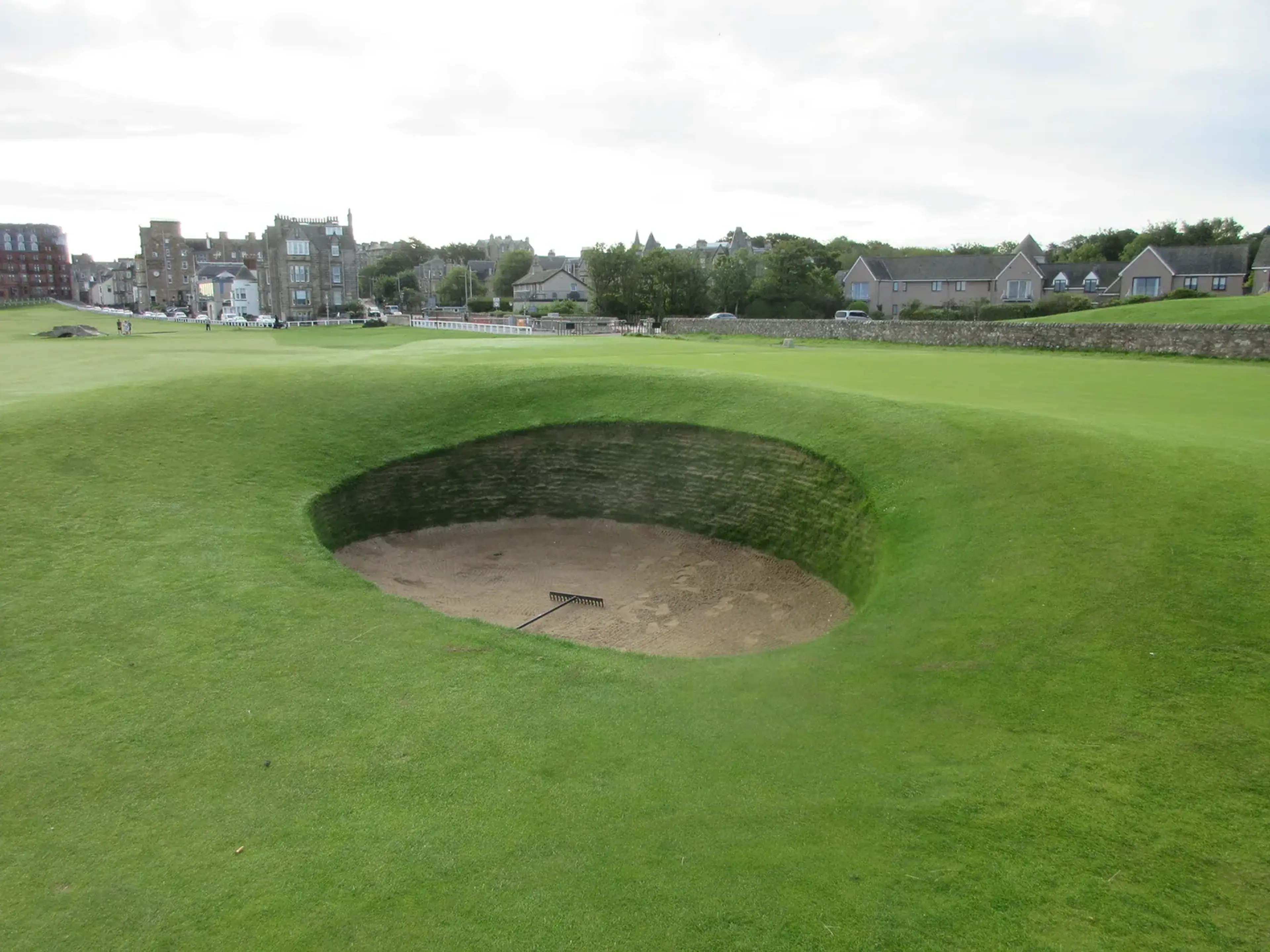
The green is long and narrow, 49 metres front to back on our data. On its left is the Road Hole Bunker, deep and steep-faced. Behind it run a road and a stone wall, both in play, which is where the hole gets its name. Our piece on iconic golf holes and their stories goes further into what has happened there in Open Championships.
Playing it
The Old Course is closed for play on Sundays, when it opens to walkers, so a Sunday visit is the time to stand on the Swilcan Bridge without holding anyone up. Tee times come through advance booking or the daily ballot, and a handicap certificate is needed on the day. St Andrews Links Trust sets the current rules, fees and handicap limits, so check with it before you travel.
How do I turn a round on the Old Course into a print?
Every hole on the Old Course is already drawn from the same mapped course data used for this guide. There are three ways to use it.
Hole in one. Pick a single hole, add a name and a date, and the print treats that hole as the subject. The 17th for the round they parred the Road Hole, the 11th or the 8th for an ace.
Contour. The whole course drawn on its own, with the double greens and the loop out and back clear on the page.
Mapping. The course drawn over its surroundings, so the town, the West Sands and the Eden estuary sit around it.
Sizes run from A4 to A0. The Classic starts from $149, The Studio from $179, and Print only from $99. If you want a file to print yourself, Instant is a 300 dpi PNG emailed within minutes of payment, from $49. Standard delivery is 4–9 business days for prints made locally. Every print is made to order, so we can't accept returns or exchanges for change of mind. But if your order arrives damaged, or with a fault on our end, tell us within 14 days of receiving your print and we'll reprint it at no extra cost, or refund you in full.
Our guide to Christmas golf gifts in Australia has order-by dates for the best chance of arriving by Christmas.
The Old Course, drawn hole by hole
Open the Old Course in the editorMore hole-by-hole guides
We have done the same for two Melbourne Sandbelt courses with MacKenzie bunkering: Royal Melbourne West, hole by hole and Kingston Heath, hole by hole. For the Australian side of the list, see Australia’s most scenic golf courses.
The Old Course at St Andrews: common questions
How long is the Old Course at St Andrews?
On our mapped course data, the straight-line distances from the back tees to the centre of each green add up to 6,376 metres, and 5,573 metres from the forward tees. The length you actually play is longer, because doglegs and the line around hazards add distance, and it changes with the tee you play from. St Andrews Links Trust publishes the current card lengths for each set of tees.
What par is the Old Course?
The Old Course is a par 72, 36 out and 36 in. It has two par 3s (the 8th and 11th), two par 5s (the 5th and 14th) and fourteen par 4s.
What is the hardest hole on the Old Course?
By stroke index, the 14th is the hardest: it is stroke index 1, a par 5 with Hell Bunker in the line of the second shot. The 17th, the Road Hole, is the one most players remember, with the Road Hole Bunker on the left of a narrow green and a road and wall behind it.
How many double greens are on the Old Course?
Seven. Only the 1st, 9th, 17th and 18th have greens of their own. On each shared green the two hole numbers add up to 18, so the 5th shares with the 13th and the 7th with the 11th.
Can the public play the Old Course?
Yes. The Old Course is a public course run by St Andrews Links Trust. Tee times come through advance booking or the daily ballot, and you need a handicap certificate. The course is closed for play on Sundays.
Is Frame the Fairway connected to St Andrews Links?
No. We are not affiliated with or endorsed by St Andrews Links Trust or The R&A. Our prints are drawn from mapped course data of the course as it lies on the ground.
The Road Hole, the 18th, or all of it
Pick a hole and a date, or print the whole Old Course in Contour or Mapping.
Start with the Old Course